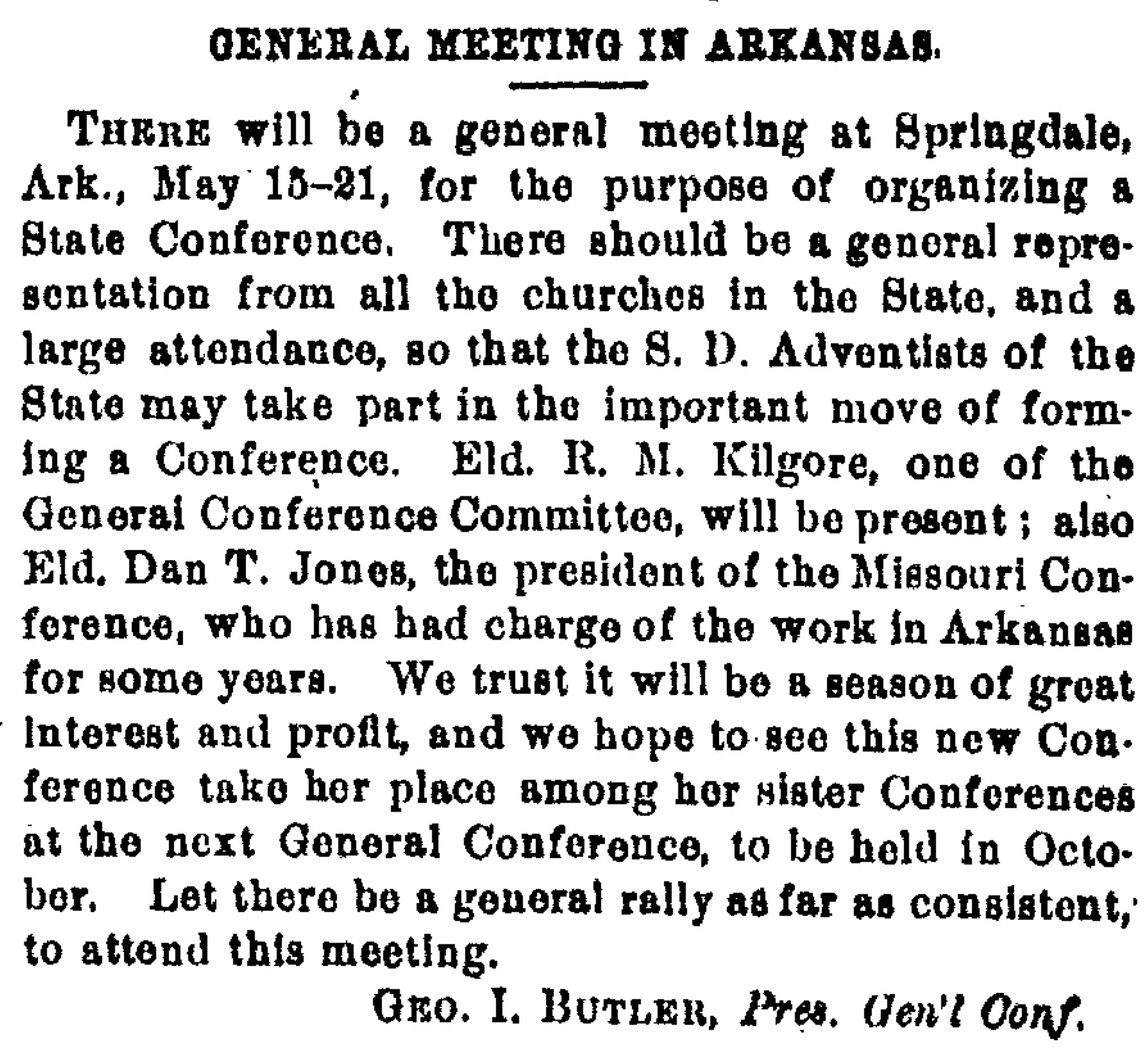
Seventh-day Adventist church organization was set up so the churches in a state combined to form a state conference, adopting a constitution to regulate their action. All the ministers in the State, were, by virtue of their office, members of the state conference, and each church was entitled to delegates according to its membership. At each annual meeting an executive committee of three was elected by vote of the delegates, of whom the president of the conference was chairman. This committee had supervision of all the ministerial and religious work of the conference between the yearly meetings, and appointed the delegates to the General Conference (Yearbook, 1884). By 1888 there were ten Seventh-day Adventist churches in Arkansas. These were Brentwood, Cincinnati, Hilltop (Harrison), Hindsville, Little Rock, Malvern, Mount Pleasant, Siloam Springs, Springdale, and Star of the West. In May 1888, an organizational meeting was held in Springdale for the purpose of establishing a state conference (Butler, 1888). The Arkansas Conference was officially organized by the General Conference on May 21, 1888, with ten churches and 226 members (GC Session, 1888). The conference organization consisted of a president, a secretary, and a treasurer, plus a small committee. For several years, the president was the only regular employee (Beeler, 1996).
Citations
(1884). Yearbook of the Seventh-day Adventist Denomination. Washington, D. C.: Review and Herald Publishing Association, pp. 9, 11.
(1888). Transcription of Minutes of General Conference Sessions. pp. 370, 371.
Beeler, Charles R. (1996). A History of Seventh-day Adventists in Arkansas and Louisiana 1888-1996. Keene: Arkansas-Louisiana Conference of Seventh-day Adventists.
Butler, G. I. (1888, Apr. 10). Review and Herald, p. 240.
Sanford Byerly Horton was born in New Orleans on February 16, 1858, and christened in the Episcopal church. During his young manhood he studied law and enjoyed a successful law practice in New Orleans, Louisiana, for several years. Sanford married Isabella Young on March 6, 1882. Two daughters, Anna and Estelle, were born to this union, but Estelle died at the age of five.
YEARS OF MINISTRY
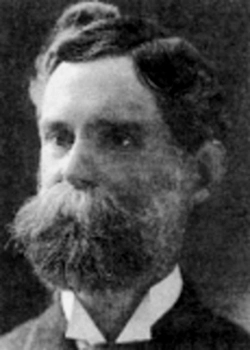
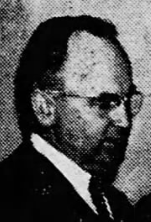
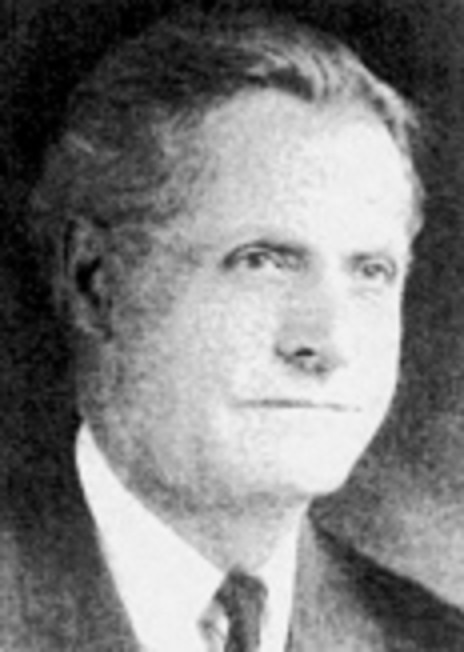
Elder S. B. Horton ca. 1901
Around 1890, guided by political aspirations, Sanford and his family went to Washington, D. C., where they heard and accepted the Adventist faith. He was called to the ministry the following summer. His years of labor were spent in New Jersey, Maryland, Delaware, Washington, D. C., Louisiana, Tennessee, New York, and Michigan. He served as a minister in the Atlantic District before his assignment in 1901, as the first president of the Louisiana Conference (Fattic, 1927). After his seven years as president of the Louisiana Conference, he was secretary of the Southern Union Conference for several years. He was very active in religious liberty affairs and served as assistant secretary of religious liberty in the General Conference, and later was head of that department in the Lake Union (Beeler, 1996).
His Final Days
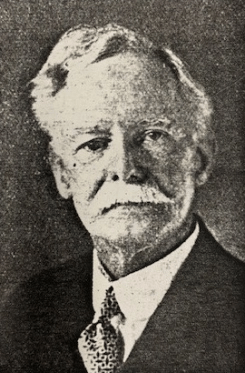
Elder Sanford B. Horton in his later years.
Elder Horton preached his last sermon in the church of which he was the pastor at Lansing, Michigan, on Wednesday evening, February 9, 1927. He became ill that night, suffering from an acute attack of Bright’s disease (Fattic, 1927). He died in Lansing, Michigan, on February 20, 1927, at the age of sixty-nine, and was buried in New Orleans (Grave, 2012), where Elder W. A. Spicer, president of the General Conference, conducted the services (Fattic, 1927).
Citations
Beeler, Charles R. (1996). A History of Seventh-day Adventists in Arkansas and Louisiana 1888-1996.Keene: Arkansas-Louisiana Conference of Seventh-day Adventists, p. 87.
Fattic, G. R. (1927, Mar. 17). Review and Herald, p. 21.
Irving Meek Evans was born on March 12, 1897, in Belmont, Ohio, to Anna May and William Clark Evans. He was the fifth of ten children, four girls and six boys. On September 15, 1915, Irving was united in marriage to Estella Mae Long. They had two daughters, Dorothy Virginia Evans and Mary Louise Evans (Ancestry, 2020).
Years of Ministry
Elder I. M. Evans in 1947 as president of the Georgia-Cumberland conference (Times, 1947).
For more than forty years Elder Evans served in various fields of leadership including field secretary in Ohio, New York, and the Southern Union, president of the Georgia-Cumberland conference and the Alabama-Mississippi conference, coming to the Arkansas-Louisiana conference in September 1954, where he served for the next nine years. During his administration many buildings and churches were erected. At Ozark Academy the dormitories known as Baker Hall and I. M. Evans Hall were completed. A new office building was completed and the headquarters of the conference moved from Little Rock to Shreveport (Times, 1975).
Elder I. M. Evans in 1960 as president of the Arkansas-Louisiana conference. Photo courtesy of the Southwestern Union Record.
Retirement Years
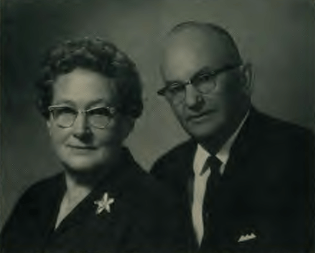
Retiring in 1964, Elder Evans was the longest-serving Arkansas-Louisiana conference president up to that time. Elder Evans and his wife moved to their place of retirement in Asheville, North Carolina (Minutes, 1963). Following a brief illness, Elder Evans passed away at his home on November 8, 1975.
Elder Irving M. and Estella Evans in 1964. Photo courtesy of the Southwestern Union Record.
Citations
(1947, Feb. 14). Conference Officers Elected by Adventists. Asheville Citizen-Times, p. 9.
In about 1871, Andrew Barnabas McAlexander and his wife, Elizabeth, moved from Missouri to Hindsville, Arkansas (Ancestry, 2005). In 1872, DeWitt C. Hunter, founder of the town of Nevada, Missouri, and the Seventh-day Adventist church there, began sending Adventist publications to his friend, Andrew B. McAlexander. Andrew and his wife began keeping the Sabbath in the spring of 1873, making the McAlexanders quite probably the first Sabbath keepers in Arkansas (Norwood, 1910). The McAlexanders also laid the groundwork for the first Seventh-day Adventist church in Arkansas.
In December 1881, the General Conference placed Arkansas under the watch care of the Kansas Conference. Elder Joseph Garner Wood was sent for an evangelistic tour of Arkansas. Elder Wood traveled first to Hindsville, a town of about 100 residents nearly twenty miles east of Springdale. He met Mr. and Mrs. Andrew B. McAlexander and reported that “their consistent Christian life had a good influence on their neighbors. Some had nominally commenced to keep the Sabbath” (Wood, 1882).
That winter Elder Wood held a nine-week meeting at Hindsville. At the end of the first two or three weeks of meetings, Elder Wood reported, “[A]bout thirty arose to testify that they believed all the commandments of God ought to be kept just as the Lord wrote them including the Seventh-day Sabbath. Ten signed the covenant. Some others are keeping the Sabbath…I baptized three” (Wood, 1882). Soon after, “from the result of this meeting nine persons took their stand for the truth, after which they were organized into a church, — the first Seventh-day Adventist church in the State” (Norwood, 1910; Rouse, 1906). A new, unoccupied log house with a fireplace at one end was arranged as a church. In March 1885, thirteen more members were baptized following a week of meetings held by J. P. Henderson.
Several years later, W. T. Martin and L. C. Sommerville, both canvassers, spent Sabbath, February 10, 1894, with the church at Hindsville. They stated that they “had, a pleasant time with them. . . . While this church has a good-sized membership, the attendance at meetings is small, as most of them live at quite a distance from their place of worship. We were detained here on account of high water” (Martin, 1894).
Although the church at Hindsville no longer exists, these early families and ministers laid the groundwork for the Arkansas-Louisiana Conference and over 13,000 members today.
Citations
Ancestry.com. (2005). U.S., World War I Draft Registration Cards, 1917-1918. Provo, UT: Ancestry.com Operations, Inc.
Martin, W. T. (1894, May 1). Review and Herald, p. 284.
Norwood, J. W. (1910, Jan. 4). Southwestern Union Record, pp. 4, 5.
Rouse, J. S. (1906, Nov. 20). Obituary. Ibid., p. 2.
Wood, J. G. (1882, Feb. 21). Review and Herald, p. 123.
In the 1930s, the church’s work was suffering from severe reductions in tithe and other income brought about by the Great Depression. The 1931 Fall Council of the General Conference Committee that met in Omaha, Nebraska, suggested extensive administrative and territorial changes in several unions across the United States. These changes reduced the number of Union conferences in North America from twelve to eight and the number of local conferences from fifty-eight to forty-eight (Record, 1932). It was at this time that Louisiana and its members and churches were transferred to the Southwestern Union Conference and joined Arkansas on February 23, 1932 (Ruf, 1932). Leaders in the Southern Union had visited about eighty-five percent of the Louisiana members, explaining the change to them. Although the members said they were willing to accept it, the change was still very difficult for them (Review, 1932). Elder R. P. Montgomery who was the Arkansas Conference president was designated president of the new organization until he took a call to Texico in June 1932, and Elder W. H. Heckman was called to take his place. Elder Heckman presided over the process of making the two states into one conference. In the new Arkansas-Louisiana Conference there were thirty-three churches, with 2,078 members, nine ordained ministers, three licentiates, eighteen teachers, and eleven colporteurs (Yearbook, 1933).
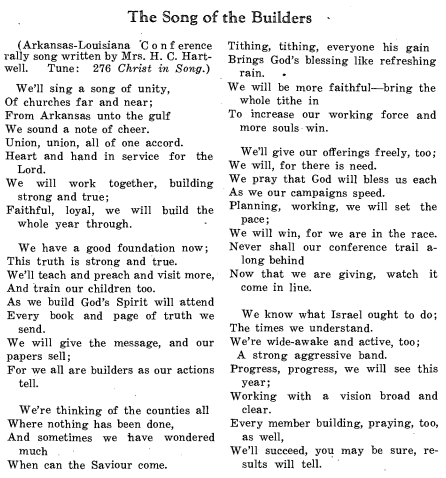
Arkansas-Louisiana Conference Rally Song
(Hartwell, 1936)
Citations
(1932, Mar. 2). Southwestern Union Record, pp. 1-4, 9, 12, 14-20.
(1932, Apr. 7). Review and Herald, p. 17.
(1933) Yearbook of the Seventh-day Adventist Denomination. Washington, D. C.: Review and Herald Publishing Association.
Hartwell, Mrs. H. C. (1936, Feb. 19). Southwestern Union Record, p. 3.
Mrs. Boling Williams, Miss Margaret Chilton, and the Roach family began meeting in the home of Mrs. A. V. Roach in Mansfield, Louisiana, in 1897 (Buecker, 1985). This led to the organization of the Mansfield SDA church on October 6, 1900, by Elder S. B. Horton following a series of tent meetings (Review, 1901). On November 17, 1902, a lot was purchased on College Street (now Louisiana Avenue) and a church was built. It was later found that part of the property belonged to P. C. Fair who lived on the corner lot. A letter from him demanded removal of the church building. The problem was resolved by an exchange of land made July 10, 1911. In 1912 the church building burned to the ground and the church records from 1897-1912 were destroyed in the fire. The lot stood vacant for two years but some of the charter members, Ruby Hill Roach, Margaret Chilton, and Ida Taliaferro, led in the purchase of an 1869 Methodist church building for $500 and for an additional $300 had it moved to the empty lot in 1914. An additional $80 was paid to cut 23 feet off the back end of the building so it would fit on the lot. The title was transferred from the Methodist church to the Louisiana Conference Association of Seventh-day Adventists on August 25, 1915. In 1944 it was transferred to the Arkansas-Louisiana Conference of Seventh-day Adventists (Review, 1915 & 1951;Buecker, 1985).
By August 1989, the congregation had dwindled to very few members after several had moved away, and older members had passed away. The building was sold to a Baptist congregation. At that time, Ida’s daughter, Edith, by then one of the oldest members, joined the Shreveport First SDA church and donated the offering plate and the platform chairs, which were very ornate wood with red velvet upholstery, from the Mansfield church to the Arkansas-Louisiana Conference of Seventh-day Adventists.
Chairs and offering plate from the Mansfield Church
Edith Buecker, daughter of one of the charter members of the Mansfield SDA Church
Citations
(1901, May 28). Review and Herald, p. 14.
(1915, Mar 25). Ibid, pp. 16, 17.
(1951, Dec 27). Ibid, p. 22.
(1969, Apr 26). Southwestern Union Record, pp. 6, 7.
Buecker, Bill. (2022, Jan 11). Phone conversation with Rebecca Burton.
Buecker, Bill. (2023, Jan 26. Text message to Rebecca Burton.
Buecker, Edith Taliaferro. (1985, Nov). History of the Seventh-day Adventist Church in Mansfield, Louisiana.
Buecker, Melvin. (2022, Jan 11). Phone conversation with Rebecca Burton.
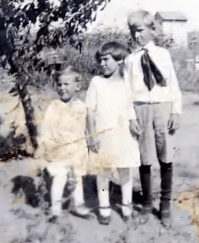
Bill with his two older siblings, L to R: Bill, Dorothy, Darrell ca. 1921 (Elder, 2018).
William Harold “Bill” Elder was born on January 14, 1917, on a farm in Salina, Kansas to William Henry and Una Elizabeth Elder. Bill grew up as one of eight children. He was the third oldest of six boys and two girls (Ancestry, 2019). Bill attended public school in Saline County, Kansas. When he was around sixteen years of age he decided he wanted to be a pastor, but he didn’t have money to go to school. He worked as a cashier at a grocery store for two years and drove a taxi for a year to earn money for college. Elder waited a few years before going to college, then spent three years at Southwestern Junior College in Keene, Texas (Elder, 2018).
Family Life
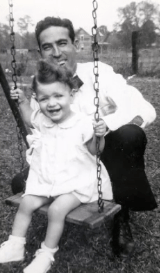
Bill Elder with one of his daughters (Elder, 2018)
Bill met his wife, Mary Lee Eaton, in Keene, Texas, at Southwestern Union College. They married on September 6, 1942, in Sebastian County, Arkansas. After they married, he attended Union College in Lincoln, Nebraska, and then graduated with a bachelor’s degree in religion from Pacific Union College in Napa Valley (Elder, 2018). The Elders, had two daughters, Donna and Mona. Bill and his family moved to Alexandria, Louisiana, where their ministerial work began (Record, 2010).
Years of Ministry
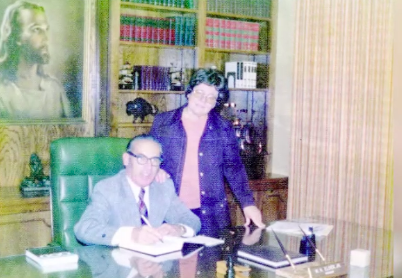
Elder Elder and his wife, Mary, in 1980 in the president’s office of the newly built Arkansas-Louisiana Conference. Photo courtesy of the Arkansas-Louisiana Conference.
After Louisiana, the Elders moved to Arkansas and then to Pueblo, Colorado, and Lincoln, Nebraska. The Elders were invited to the Arkansas-Louisiana Conference to head the Departments of Sabbath School, Religious Liberty and Communications (Record, 2010). Five years later, they moved to Pennsylvania for six months, and he was departmental director in the Northern Union Conference. From that position he became the president of the North Dakota Conference. He moved from North Dakota to Shreveport in 1974 to become the Arkansas-Louisiana Conference president. In 1982, Elder Elder, as he was called, decided it was time to retire (Elder, 2018).
Retirement Years
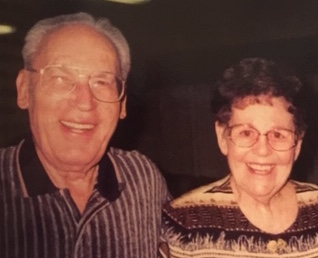
Elder Elder at age 93 with his wife, Mary, in 2010. Photo courtesy of the Southwestern Union Record.
The Elders moved to Redlands, where he spent four years as the wills and trust director of the Quiet Hour. After leaving the Quiet Hour, Elder began writing the first of two books, in 1988. The book, Hearts in Harmony, centers around Samuel, Jonathan and David, from the Bible.“It’s a trilogy and how their lives intertwined and intersected,” Elder said. “It makes a wonderful story.” A second book was written in response to author Christopher Hitchens, who wrote a book called God Is Not Great. I read it twice and I decided to answer it,” Elder said. He wrote his book God Is Exceedingly Great, in two years (Elder, 2018).
The Elders, celebrated their 76th wedding anniversary in September, 2018. They had been members of Banning Seventh-day Adventist Church for sixteen years. Bill preached a sermon in the Banning SDA Church on his 100th Birthday and also on his 101st Birthday (Elder, 2018). Elder Elder passed away on December 22, 2018, in Loma Linda, California, just three weeks short of his 102nd birthday (Ancestry, 2019). He served a total of twenty-two years in the Arkansas-Louisiana conference.
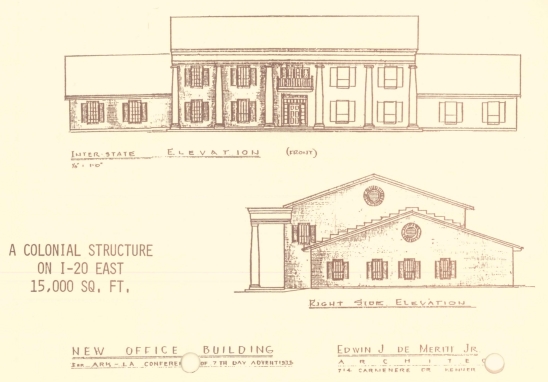
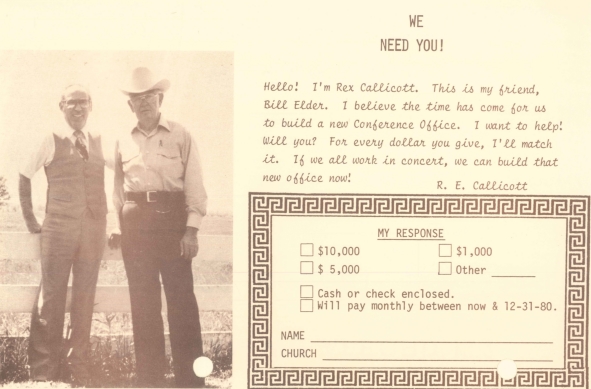
1980 elevation sketch and Rex Callicott’s matching plan to raise money for the new conference office.
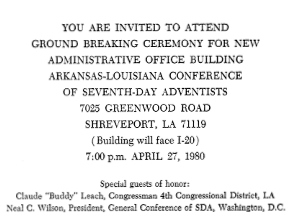
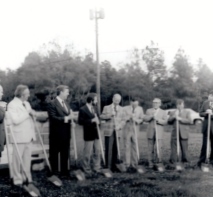
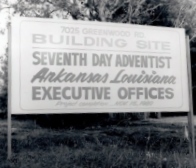
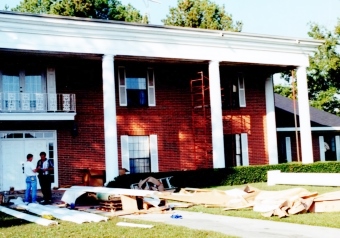
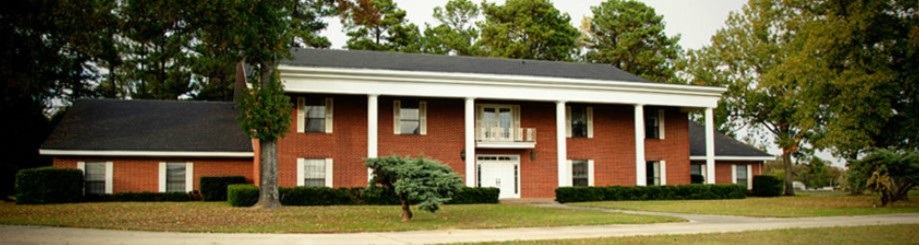
On Sunday, April 27, 1980, ground was broken and construction began (Hancock, 1980). The old office sold for more than had been budgeted and the new office was built for less than budgeted, thanks to many hours of volunteer labor. The beautiful 15,000 square-foot office at 7025 Greenwood Road was designed inside and outside to look like an old colonial home. The move to the new building was made in the fall of 1980. An open house was held December 20, 1981, followed by a dedication service (Griffin, 1981). Meanwhile, the northeast corner of the property had been designated for the Book and Bible House (later Adventist Book Center). It opened for business in 1981. A house on the northwest corner of the property, which was not part of the original land purchase, was offered for sale by the owner. In 1981, it was voted to purchase this house on eight-tenths of an acre (Minutes, 1981).
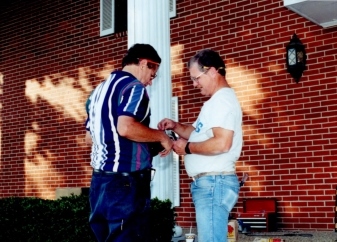
Jerry Mayes and Ron Ray making some renovations in 1997Ron Ray and Jerry Mayes working on the soffit
Arkansas-Louisiana Conference of Seventh-day Adventists. Photos courtesy of the Arkansas-Louisiana conference.
Around 1889, a church was organized east of Hardy by Elder James P. Henderson and Mr. Divelbiss. By 1908, Mr. and Mrs. Andrew Smith were the only members left, although several who used to attend the church still believed the Sabbath truth (Littell, 1908).
SPRING RIVER CHURCH ORGANIZED IN 1991
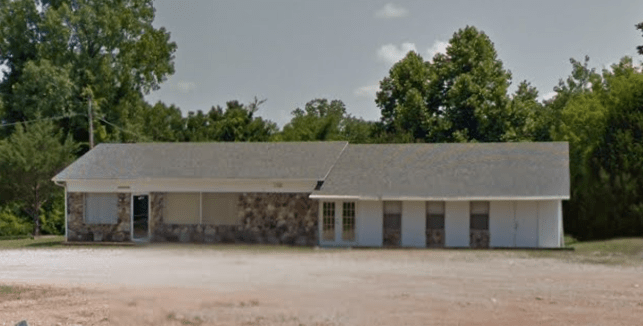
The Spring River church was organized in 1991. In November 2001, the congregation purchased some property with an existing structure to renovate in nearby Williford. Pastor Bill Sorenson worked tirelessly in heading up the project of renovating and building a new addition (Sorenson, 2006).
Property purchased in 2001 to be remodeled as a church (Minutes, 2001).
A NEW CHURCH IN 2001
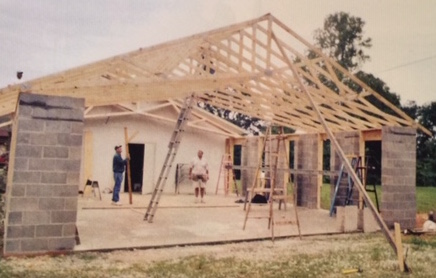
In spite of challenges — a tire blow-out on a trailer loaded with cement blocks, and a strong wind blowing over a stacked wall of blocks — God blessed their project. He sent the help of a pastor’s son and friend from Dallas, when it was needed. The beautiful new church included rock decor to enhance the structure (Sorenson, 2006).
New addition to the Spring River church. Photo courtesy of the Southwestern Union Record.
Spring River church on Highway 63 in Williford, Arkansas. Photo courtesy of Google Maps, 2018.
Citations
(2001, Oct. 15). Minutes of the Arkansas Conference Association Board. Shreveport, LA: Arkansas-Louisiana Conference of SDA.
Littell, Leslie. (1908, May 5). Southwestern Union Record, p. 2.
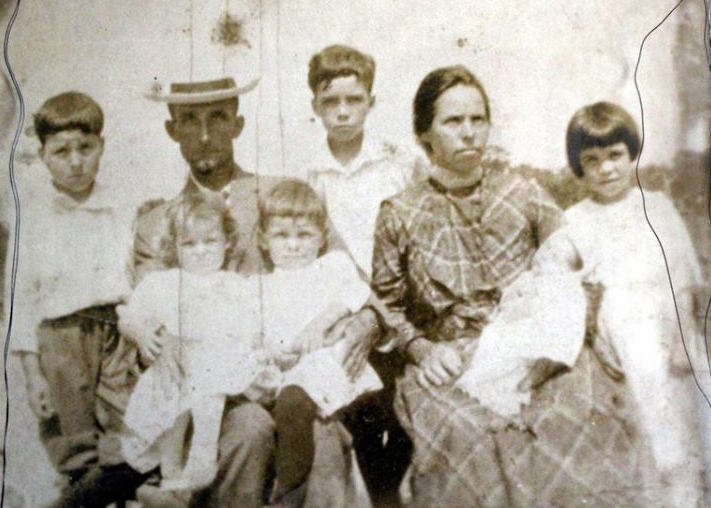
Arthur Lee McCoy and Ava Etta (Hopkins) McCoy with their family. L to R: Earl, Arthur holding Jewell and Joe, Arnold, Ava holding Avalee, and Prue (Ancestry, 2017).
The work in this area really began when Joseph Franklin McCoy moved from Louisville, Kentucky, to Lucky, Arkansas, in 1878. There, Joseph married and raised his family. Joseph, had begun keeping the Sabbath from reading his Bible. He then sent for Adventist tracts, papers, and books, and accepted the third angel’s message. Joseph was arrested and persecuted for violating the Sunday laws that were in effect at that time. Following that, he and his wife with their three boys, organized the first Sabbath school in this area. They brought in their neighbors and friends with their children and studied the Bible together. Soon Charley Ewing and his family began keeping the Sabbath. Seventh-day Adventist ministers would visit occasionally, among whom were Elders Beckner and Ellington Beck Hopkins (McCoy, 1910).
LUCKY CHURCH ORGANIZED IN 1906
Elder Volney B. Watts ca. 1908
In the fall of 1906, Elder Henry Clay Griffin and H. L. Parker held meetings at Lucky, and in November, Elder Griffin baptized some and organized a church of seven members, mostly from the McCoy and Ewing families. The members had already built a little church in a pine grove between the two families, which was not quite finished but they were meeting in it (Griffin, 1906). The church continued to prosper and grow rapidly and at the twentieth annual session of the Arkansas Conference in July 1907, Lucky was admitted as a church (Record, 1907). From 1909 to 1912, Elder Volney B. Watts did pastoral evangelism especially around Lucky and Fort Smith. By 1910, Lucky was the second largest church in the conference (McCoy, 1910). The little community of Lucky no longer exists, but by 1931 the church became known as the Bonnerdale Church (Hopkins, 1931).
A NEW CHURCH IN 1941
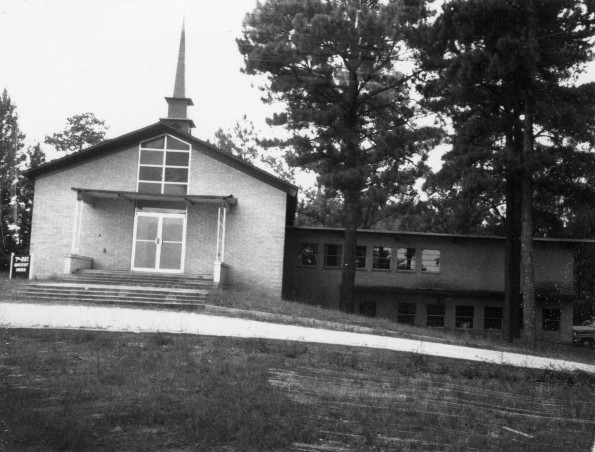
In 1941, the Bonnerdale members completed a new church that was quite large and accommodated more seating than their previous building (Record, 1941). The church was dedicated on November 29, 1941.
Photo courtesy of Don Hevener.
A NEW CHURCH IN 2005
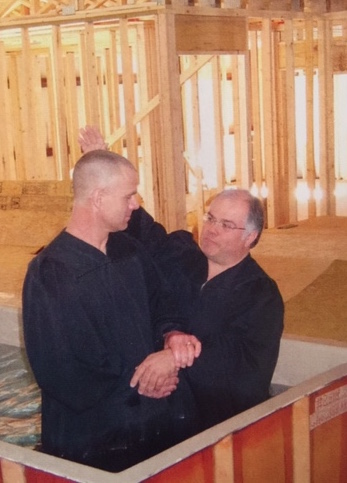
Baptism in the unfinished Bonnerdale church on December 25, 2004 (Record, 2005).
At the end of 1976, Irvin and Evea J. Bainum donated property on which to build a new church and school. The school and Ewing Auditorium were built first. The congregation met in the new auditorium for the first time on December 22, 1979, and the school opened for the 1980-1981 school year (Record, 1979). In 2003, Bonnerdale finalized plans for a new 10,176 square foot sanctuary with the old sanctuary to be razed. They began work on the foundation in June (Shafter, 2003; cf. Minutes, 2002). In November 2005, members formally moved into their new facility. At the end of November 2006, they celebrated the congregation’s first 100 years (Winton, 2006).
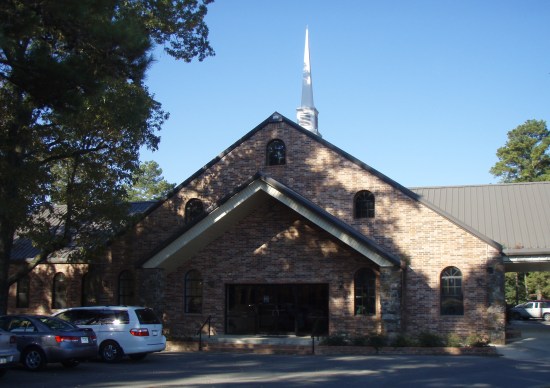
Bonnerdale church on Adventist Church Road in Bonnerdale, Arkansas. Photo courtesy of Stephen Burton.
Citations
(1907, Aug. 13). Southwestern Union Record, p. 2.
(1941, Nov. 11). Ibid., p. 3.
(1976, Dec. 17). Minutes of the Board of Trustees of the Arkansas Conference Association. Shreveport, LA: Arkansas-Louisiana Conference of SDA.
(1979, Dec. 13). Southwestern Union Record, p. 12F.







 How it all Began